Do you remember what you wore in college? Even though it was eons ago, I do: Guess jeans, bright-colored Esprit sweaters, K-Swiss sneakers, and a navy peacoat over everything. Every once in a while, I would mix it up and wear my crewneck “college” sweatshirt over a turtleneck. The peacoat was purchased at the Army-Navy Surplus store that was just east of campus and was like a uniform for girls my age; we all wore them pretty much every (cold) day. I don’t know if these clothes would have been considered trendy at the time, and honestly I don’t remember caring about trends when I was 20 (I’m kind of proud to say I managed to never own any leg warmers or acid wash). And I basically wore the same thing(s) for four years. When I moved to New York for my first job after college, I had nothing professional to wear, so I went to Ann Taylor and bought two wool pencil skirts and three lightweight sweaters, and for the next three years, I mixed and matched those pieces as my work uniform.
The point? I didn’t have very many clothes, and what clothes I did have were pretty basic. But I gotta say, I (generally) looked nice. By the time I left NYC, my work “wardrobe” also included a black skirt suit and a couple silk blouses, but I’m pretty sure I was still wearing my jeans from college.
The larger point: I didn’t shop much (couldn’t afford it), but I also didn’t feel the need to because I wasn’t constantly reminded to shop. Sure, I loved the Gap and Esprit (and Benetton!) ads, but I had to go out and buy a magazine if I wanted to see them. I didn’t have a barrage of emails and social media posts constantly telling me I needed something new.

Talk about a brand that was ahead of its time.
Another thing we didn’t have back then: fast fashion.
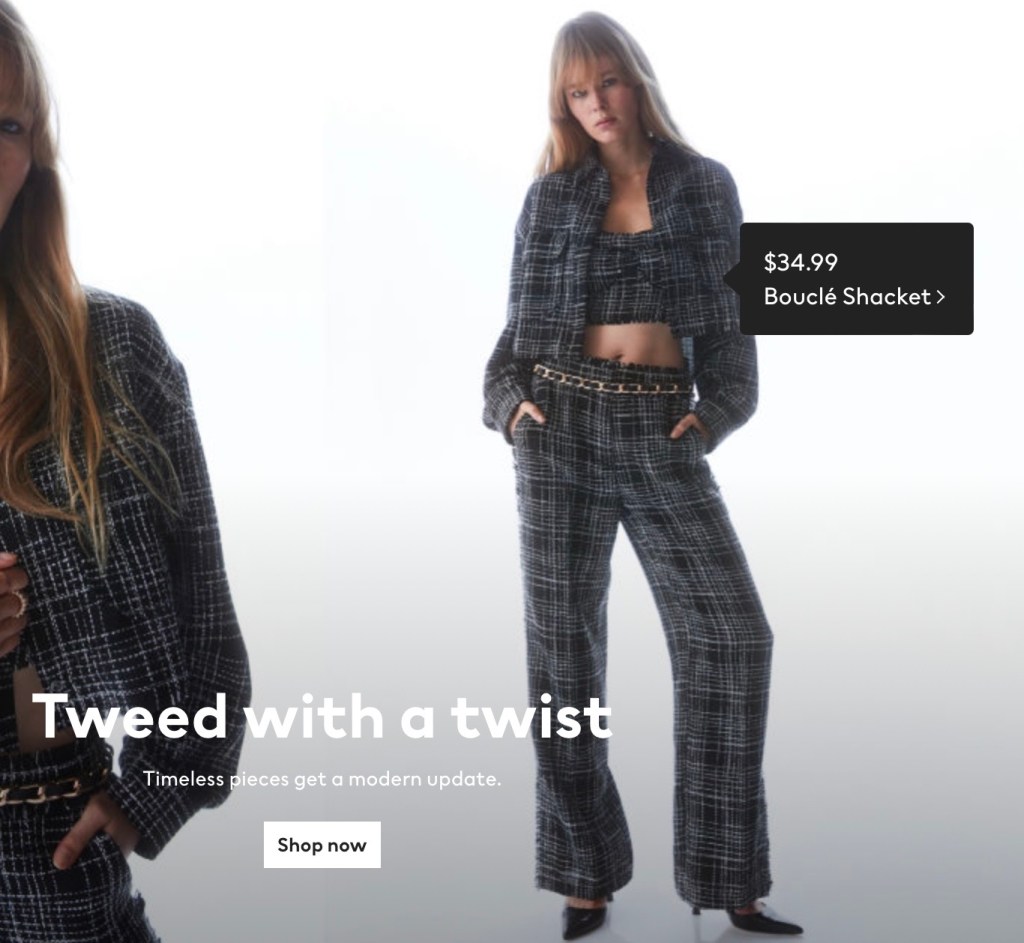
“Fast fashion” is a term I had never heard before a couple years ago. It refers to clothing that is made to mimic rapidly changing designer trends without the designer price tag. So you can get the Chanel-esque bouclé suit above from H&M for roughly 50 bucks (hey, it’s now on sale) as opposed to spending 5k or whatever Chanel actually costs. What could be wrong with that?
Well, in turns out there’s a lot wrong with that: Cheap clothes actually have a very high cost.
Fast fashion, which is really all about the pressure to always have something new, relies on cheap manufacturing, frequent consumption, and short-lived garment use. As you can imagine, it’s bad for the environment and especially for people in developing countries. According to the UN, the fashion industry is responsible for 8–10% of global emissions (more than aviation and shipping combined). According to a study published on nature.com, “Impacts from the fashion industry include over 92 million tons of waste produced per year and 79 trillion liters of water consumed.”
Other key points from the study:
- The textile and fashion industry has a long and complex supply chain, starting from agriculture and petrochemical production (for fiber production) to manufacturing, logistics, and retail.
- Each production step has an environmental impact due to water, material, chemical, and energy use.
- Many chemicals used in textile manufacturing are harmful for the environment, factory workers, and consumers.
- Most environmental impacts occur in the textile-manufacturing and garment-manufacturing countries, but textile waste is found globally.
- Fast fashion has increased the material throughput in the system. Fashion brands are now producing almost twice the amount of clothing today compared with before the year 2000.
- Current fashion-consumption practices result in large amounts of textile waste, most of which is incinerated, landfilled, or exported to developing countries.
Ugh.
I read recently that Zara produces 840 million garments per year, and that number is constantly growing. Here’s a quote from Amancio Ortega Gaona, founder of Zara: “With Zara, you know that if you don’t buy it right then and there, within 11 days the entire stock will change. You buy it now or never. And because the prices are so low, you buy it now.” Obviously the focus here is on speed and quantity over quality. (Also obvious: He’s another guy who doesn’t need any more of my money.) These clothes are not meant to be worn for four months, let alone four years straight.
Which brings us to massive amounts of waste. According the EPA, 85% of textiles in the U.S. are thrown away (only about 13% are recycled). It’s all so…icky. Just thinking about it weighs me down and makes me feel terrible about my past Zara “hauls.”
But here’s the thing: It’s a choice. I know not everyone can afford expensive clothes (and I’m not talking Chanel) or even mid-priced clothes. But we all can be more mindful of what we buy. And maybe try to find higher-quality (or, yes, secondhand) alternatives to those trendy pieces, even if it means buying…(gasp) less. And if you do buy something from H&M or Old Navy—or, let’s be frank J.Crew or Anthropologie—make sure you love it, and wear it like you mean it. Like it’s a uniform.
When I first started writing about food and learned about the nasty, unpronounceable ingredients and inhumane industrial farming practices that go into making so much of what’s in the grocery store, I felt like Neo in The Matrix — once you know these things, you can’t un-know them. Now, I’m in the same place with shopping and clothing. And, since I can’t un-know these things, I’m doing my best to stop being a part of the problem.


 My Secondhand Year
Leave a comment